




by Ilaria Myr
aleXsandro Palombo, street artist and creator of memorable, unconventional murals, speaks out. His are painful images inspired by current events, uncomfortable works that are periodically vandalized and erased by fanatical extremists. His themes? The Shoah and Memory, the victims of October 7, but also disability, illness, abuse, and femicide… Art that bears witness. Because “memory is the only bulwark against indifference, and indifference is always the first step towards the worst.”
He is known as ‘the faceless artist’ who amazes every time with his socially critical murals that ‘pop up’ on the walls of Milan. No one has ever seen his face, but he is internationally known for his provocative and always thoughtful works, which focus on themes of great socio-cultural relevance. His is an art “of rights,” and he has been dubbed by the Jüdische Allgemeine as “the anti-Banksy” (another well-known “hidden” urban artist, but with opposing views on issues such as anti-Semitism, terrorism, and memory). aleXsandro Palombo is this: a pop artist who has chosen total privacy about himself, without giving rise to simplistic categorizations or judgments, because he wants his art to speak for itself.
Originally from Salento but Milanese by adoption (he has lived in Milan for thirty years), Palombo continually leaves his mark with reflective and irreverent works focusing on pop culture, society, inequality, inclusion, diversity, ethics, and human rights.
The link with the memory of the Shoah
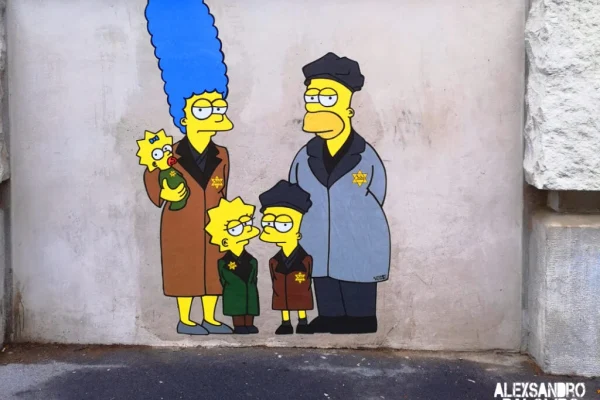
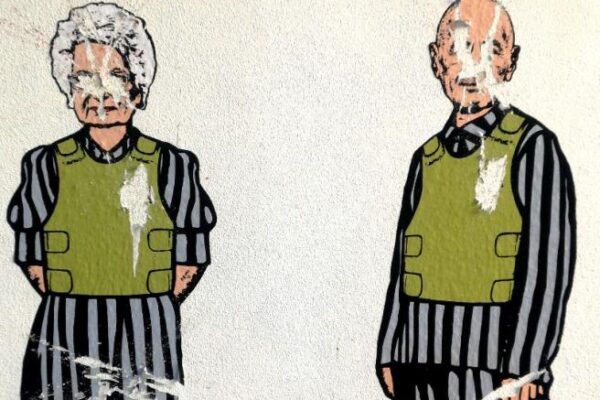
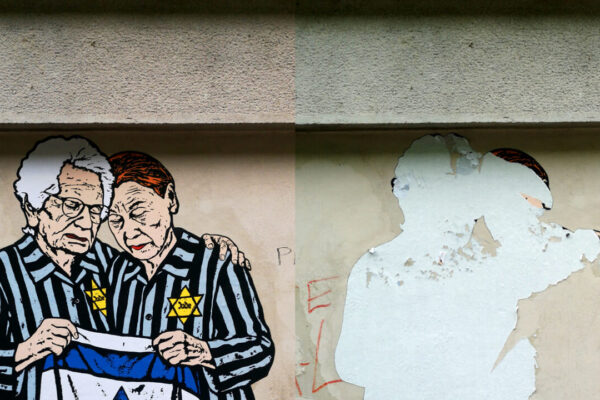
Many of his works are dedicated to the theme of the Holocaust: the best known are those that appeared outside the Shoah memorial in Milan for Holocaust Remembrance Day in 2023, depicting the Simpsons dressed as deportees, followed in 2025 by other murals: Anti-Semitism, History Repeating, with Liliana Segre, Edith Bruck, and Sami Modiano, and The Star of David, depicting Edith Bruck in the flag with the Star of David. After being vandalized, both works were acquired by the Shoah Museum Foundation in Rome.
But that’s not all. On January 29, a new mural by him appeared on the Caserma Montello, in Via Michele Amari, at the corner with Via Francesco Caracciolo in Milan, depicting Primo Levi and Anne Frank sitting on the ground in Auschwitz deportation uniforms, gazing at a sky of yellow stars, the same stars that Jews were forced to wear sewn onto their clothes. It was created on Holocaust Remembrance Day on what remains of the works dedicated in 2025 to Holocaust survivors Liliana Segre, Edith Bruck, and Sami Modiano.
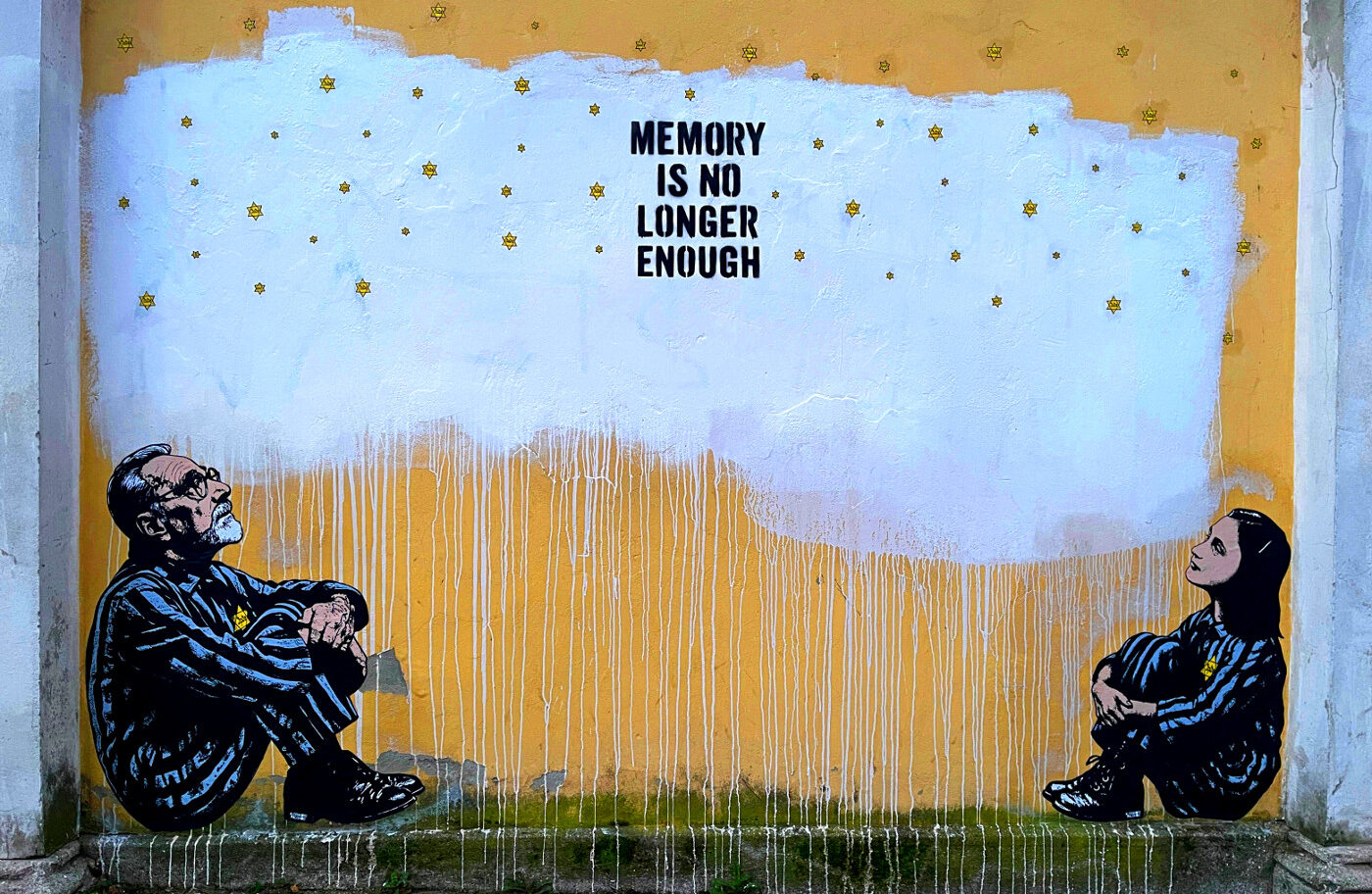
After only four days, however, the new work suffered the same fate, Primo Levi’s face was defaced, and memory was once again violated: an act of violence that symbolically strikes at his testimony and the civic value he represents.But despite similar incidents being a constant occurrence—with the latest bringing the total number of acts of vandalism against his works dedicated to memory to 17—Palombo never stops believing that donating his art and placing it in public spaces, putting it at the service of important issues such as memory and humanity, is increasingly urgent. To hear directly from him what drives his art and his commitment, we contacted him for an interview, even though we knew that he almost never grants them, despite frequent requests from prestigious and internationally renowned media outlets. And – we say this with pride and gratitude – he gladly accepted our request, giving us his time generously and profoundly.
For years, your art has addressed topics of great social and cultural relevance that you want to raise public awareness about. What drives you to choose a particular theme for a work?
The search for truth, rather than beauty, is what guides my work. I am interested in what is concrete, essential, everything that allows reality to be told without filters. For me, it is a form of active memory, a way of not turning away from the indifference and inhumanity that surrounds us.
Many works are born from personal experiences, from wounds that become a need to say something, and from a process of social investigation carried out in the field. It is my way of being in the world and reaching out to others, connecting with what is human, with those conditions that can change the destiny of people and communities.
Social issues cannot be treated as a passing trend or an intellectual exercise, even though this often happens today. Addressing these issues means taking responsibility for people’s real lives, for our times and their complexity, with their gray areas and uncomfortable truths. It is precisely there, where many look away, that I choose to be.
Among these is the Shoah, to which you have dedicated several murals. What motivates you to address this issue, especially at a time when the Shoah is being questioned because of the tragedy in Gaza? Is there a desire on your part to “provoke” those who would like to trivialize it?
Today, words such as “genocide” or “Holocaust” are used so lightly that it shows that trivialization has already exceeded the limit and is no longer a danger; it has become the norm. For me, dealing with the Shoah is first and foremost a moral responsibility. I grew up in an era when memory was a serious matter, recounted without filters. The Shoah was absolute horror, something that could not even be mentioned lightly. I remember well that even joking about certain topics was unthinkable, because it meant crossing a line that should not be crossed.
This education has stayed with me. My grandfather talked about the war, hunger, and misery, and you understood that memory was not a school exercise, it was a way to remain vigilant. Evil is not an abstract concept, it is something that can return if we stop recognizing it, and the times we are living in confirm this every day.
Today, the context is completely different. We live in a fast-paced and superficial world, where everything is consumed in a matter of seconds. The younger generations are inundated with overlapping information, often lacking in depth, and this makes memory a fragile terrain. This void is filled with simplifications, distortions, and manipulations that transform the Holocaust into just another piece of content. The traditional languages of memory risk no longer reaching younger people, and this is already tangible. An image in the public space can open a gap where words cannot reach. Art does not replace history, but it can become a bridge, a way to bring memory back into the present and make it perceptible again. For me, it is not a random choice. It is part of my heritage, of what I have received and feel I have a duty to give back. Talking about the Shoah today is more difficult, but that is precisely why it is necessary. Memory is the only barrier we have against indifference, and indifference is always the first step towards the worst. We are beyond the threshold of trivialization, and that is precisely why we cannot afford to remain silent.
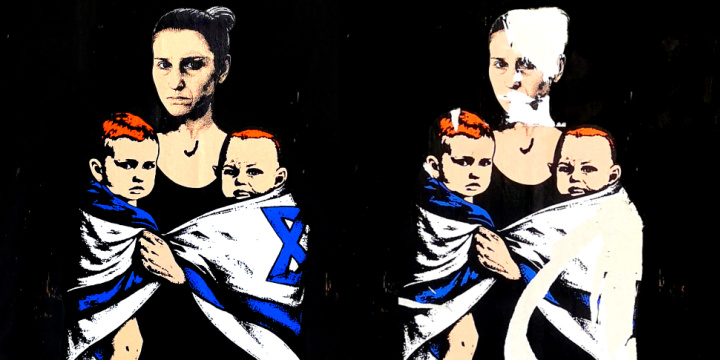
The same question applies to the mural you created dedicated to Mrs. Shiri Bibas and her two children, Kfir and Ariel, who were kidnapped and brutally murdered in Gaza. What did you mean to convey with this work, which you surely knew would provoke those who deny October 7, as indeed it did?
That work depicts a real moment, the scene in which Shiri Bibas was dragged away by Hamas militants with her children in her arms. Portraying a mother clutching her children in such an extreme moment means touching the deepest point of human pain. It is not a political gesture, it is a universal gesture. Shiri with Kfir and Ariel represents not only one affected family, but all mothers who, in every time and place, have tried to protect their children from violence.
Wounded motherhood is the point where brutality shows itself for what it is, a direct attack on innocence. A mother embracing her children is both vulnerability and resistance. It is an image that transcends cultures, religions, and borders.
To capture that moment is to restore its truth, especially at a time when horror is denied and manipulated. Shiri with her children is an open wound; to look at her is to take responsibility for not looking away.
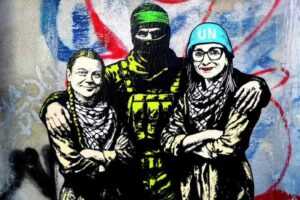
The penultimate one you created, “Human Shields,” which depicts Greta Thunberg and Francesca Albanese embraced by a Hamas terrorist, is an explicit criticism of Western activism and the ambiguities of contemporary debate, which also calls into question the role of the UN in the Palestinian context. His stance is very clear, exposing him to criticism and attacks, even on social media…
I am not concerned about criticism or attacks on social media related to this type of work. What I do find disturbing is that insults and threats directed at me have become the norm simply because I create works that keep the memory of the Holocaust alive. It is disconcerting to see how dealing with the Shoah, an event that marked the lives of millions of Jews and the history of humanity, is now perceived as something problematic, almost an extreme position. We have reached the point where remembering tragedies of such inhumanity is no longer considered a duty but an obstacle and sometimes even a risk. The hostile climate and the serious threats directed at me clearly show how deep this drift is. Every day I experience firsthand the gravity of the moment we are living in, with verbal attacks and intimidation of a clearly anti-Semitic nature directed at me even though I am not Jewish. And this is precisely what reveals the nature of the problem, because when hatred also affects those who are not Jewish, it means that the target is not the person but the very idea of the Jew. History has already shown us where this language can lead, and seeing it reemerge so easily means that the memory of the Shoah is no longer protecting anyone.
There is another factor that weighs heavily: some of the activists who fill the squares today never distance themselves from violence and end up normalizing openly anti-Semitic language and slogans. They call themselves pacifist demonstrations, but they are often filled with chants and symbols that are anything but peaceful. The silence of those who lead these demonstrations, the lack of sincere and clear condemnation, contributes to making acceptable what should never be acceptable.
These demonstrations are not doing the Palestinian cause any favors, and part of the responsibility also lies in the way the issue is addressed at the institutional and political level. The debate on the bill against anti-Semitism has highlighted deep divisions, ambiguities, and mechanisms of convenience that prevent a clear position from being taken, even as hatred grows before everyone’s eyes. We cannot slow down such an urgent and necessary measure for the protection of society and its citizens and then be surprised when anti-Semitism spreads. It is disturbing to see how political hesitation and calculation prevail over the need to protect and safeguard civil coexistence, with a clear desire to postpone what instead requires immediate responsibility. Must we really wait for a serious incident to occur here, as happened in Sydney during the Hanukkah celebrations or in other parts of the world, to understand the gravity of the moment?
The activism that dominates today has little to do with social welfare or human rights. It is a superficial activism that follows the emotional wave of the moment. Causes are changed like slogans, not out of conviction but out of convenience. When an issue stops making noise, another one is adopted that is more useful for remaining visible. It is a mechanism that involves many public figures and is a sign of a time when exposure is worth more than consistency.
Many movements are not born out of solidarity but out of the need to be there. The cause becomes a backdrop, a pretext. Indignation turns into a performance and participation into a gesture of identity, using the suffering of others as an opportunity to fuel one’s own role. It is a dynamic that empties issues of meaning and reduces them to tools, while those who should be at the center of the discussion disappear.
Recently, works on the Shoah, the Bibas family, and those criticizing Hamas terrorism have been vandalized. But every time this has happened, you have redone them. How do you feel and what do you think every time this happens? Why is it so important for you to continue?
Those who erase a mural about the Holocaust, the Bibas family, or against Hamas terrorism are not attacking me; they are trying to eliminate a fragment of truth that disturbs them. Every time it happens, I feel a sense of bitterness and lucidity. Bitterness because attacking an image is always a sign of a deeper aggression, one against memory and against the innocent. Lucidity because that very gesture confirms how necessary it is to continue. Sometimes, recreating a vandalized work is an act of responsibility and resistance: I don’t give up and I continue because those faces and those stories must not be left alone.
These attacks show how fragile the ground on which our democracy stands is and how easy it is to crack it. These are not marginal episodes, they are not normal, they cannot be dismissed as pranks. Every time a work is attacked, a wider crack is revealed, a weakening of our ability to defend what should remain untouchable. When an image is removed because it is considered uncomfortable, it means that freedom has already been wounded in its most exposed point. And when these acts are minimized, we lose sight of the danger they represent.
They are essential elements of our democratic life, and when they are undermined, the entire system that supports them is called into question. A society that accepts the erasure of images that challenge it is a society that is giving up its cultural antibodies, those that prevent drift and barbarism.
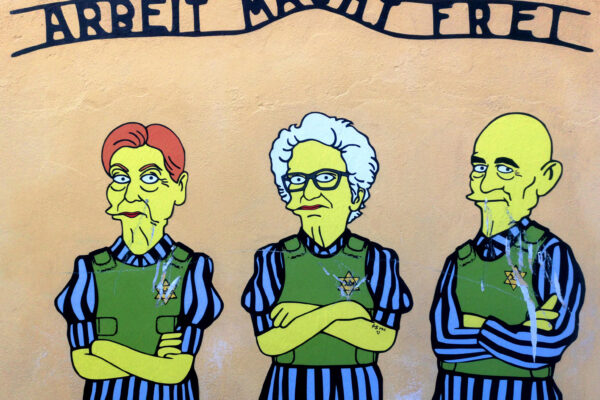
Art has always been a place of awareness and resistance, a space where the community can recognize itself and question itself. If we do not protect it, we deny what has shaped us and what history has given us as our common heritage. Even before the most recent events in the Middle East, my works were targeted with anti-Semitic graffiti and symbols were erased, as happened with the work dedicated to the Simpsons in Auschwitz. These were clear signs, but they were often ignored, as if they did not concern anyone. In reality, they indicated a drift that was already rooted in our urban fabric and that is now clearly evident.
We are witnessing a distorted use of words and concepts, which are being overturned and manipulated to the point of losing their original meaning. It is no coincidence that the word ‘genocide’ was instrumentally overturned and transformed into an ideological brand against the Jewish people in the days immediately following the Hamas attack, even before Israel had begun to defend itself. This semantic distortion not only alters historical and political truth, but also fuels a toxic narrative that legitimizes hatred and erases the responsibilities of terrorism. On social media, this process is amplified and becomes a self-perpetuating machine of disinformation. That term has been repeated insistently until it has become the cornerstone of a systematic campaign. This is why I continue on my path without taking a step back, because every image that is attacked reveals how urgent it is to defend what it represents and to reestablish the truth.
What do you want to say to young people in particular with your work?
Young people don’t need a sermon, they need a perspective, and art can offer that when it manages to remove the background noise and show what is usually avoided. Reality is not a screen to scroll through, it is a place you enter. Some people prefer to stay on the surface and are free to do so, but nothing grows there. I don’t have a message to impart, if anything, an invitation not to accept the most convenient version of things, not to confuse visibility with truth, not to let propaganda think for you.
Complexity must be perceived as a possibility and not as an obstacle. It is not a labyrinth but a training of the gaze, because that is where consciousness is formed and that is where freedom begins. Thinking for oneself is still the most revolutionary act we can perform.
Are there any works that you are particularly fond of or have a special connection with? Which ones? Why? Would you like to tell us how some of them came about?
Some works have accompanied me for years, like paths of research that are not only visual but also human, in which I have tried to transform personal experiences into a perspective that could be shared. My story actually begins before art. As a boy, I learned the value of care and responsibility through volunteering with the Red Cross; later, with the Navy, I crossed seas and borders, participating in rescue missions and operations in contexts marked by war and migration. I encountered fragility, injustice, and suspended lives up close. All this has had a profound effect on my way of looking at the world, teaching me that every face carries a story and that human dignity is always the first boundary to defend.
Perhaps this is why some works stay with me more than others, because in each one there is a fragment of that past, transformed in an attempt to give meaning, memory, and responsibility to what I have seen. Among the works I am most attached to are those dedicated to the memory of the Shoah, now in the collection of the Shoah Museum in Rome, the portraits of Liliana Segre, Edith Bruck, and Sami Modiano. Working on their faces meant confronting a memory that does not belong only to the past but continues to question us. In them, I saw the strength to transform trauma into testimony and silence into commitment.
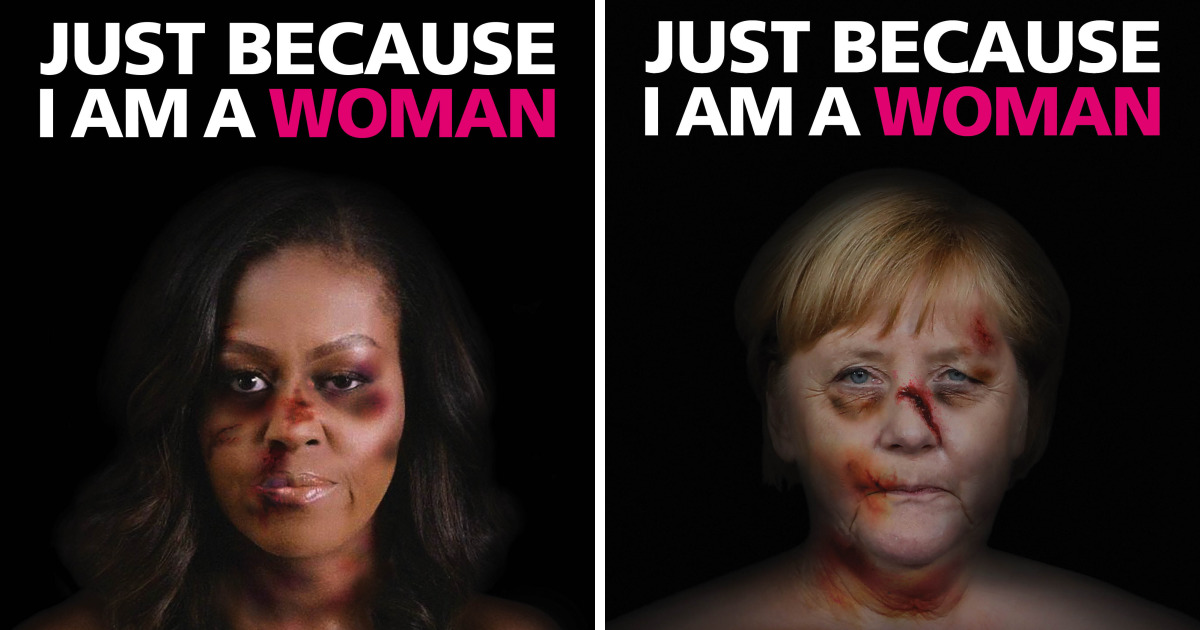
On the subject of gender-based violence, the project I feel most connected to is Just Because I Am a Woman. I chose to portray women world leaders as vulnerable and wounded figures, yet capable of resistance, to remind us that gender-based violence can affect anyone, regardless of their role or power. The fact that this work has been accepted in institutional contexts has reinforced the message, but its origin remains deeply linked to an ethical rather than an artistic necessity.
Survivor is a series dedicated to breast cancer, born out of personal loss. It is a work in memory of a woman who was part of my life for many years. Through these portraits, I have tried to restore strength and dignity to those facing an illness that marks the body and existence, without rhetoric, but with respect.
Another important project for me is “Disabled Disney Princesses,” created in 2013. Through figures from the collective imagination, I tried to question the idea of perfection and imposed standards of beauty at a time when the issue of inclusion was still largely absent from public debate. This work was created during a long hospital stay and was, for me, a way of reacting to a condition that changed me profoundly.
I am also very attached to the works dedicated to the Iranian people, created in front of the Iranian Consulate in Milan in response to the regime’s repression. The image of Marge Simpson cutting her hair in solidarity with Mahsa Amini was erased several times, and after each removal I recreated it, recontextualizing it, so that attempts at censorship and silence would not be the final answer. The same spirit guided the portrait of Ahou Daryaei, the student arrested after a gesture of protest that many young Iranians felt was their own. In a context of ongoing violence, those images remain for me an invitation not to look away.
After all, every work that carries with it a part of my journey is also an act of survival. Art has allowed me to go through pain without being destroyed by it, to transform vulnerability into testimony, and to give back to the world not only suffering, but also the possibility of awareness.
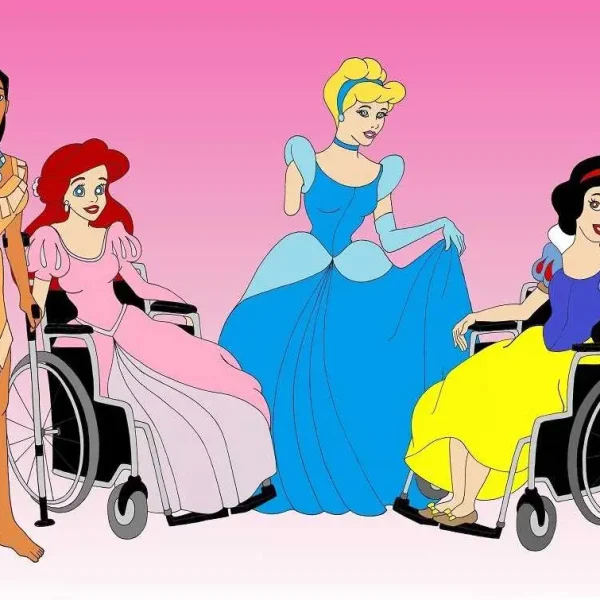
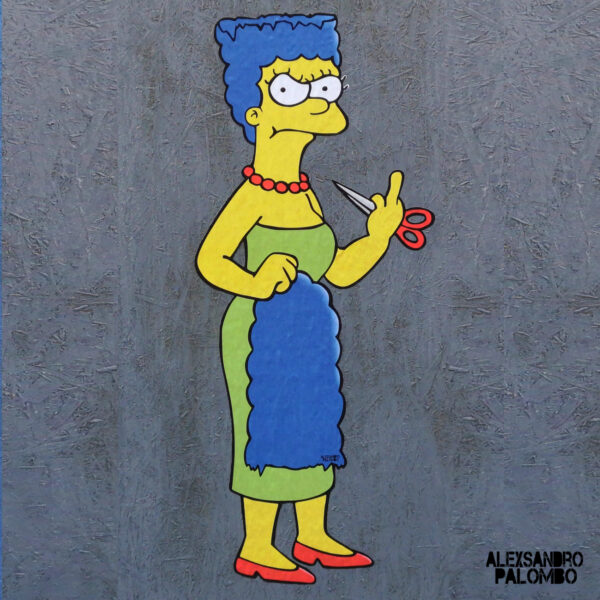
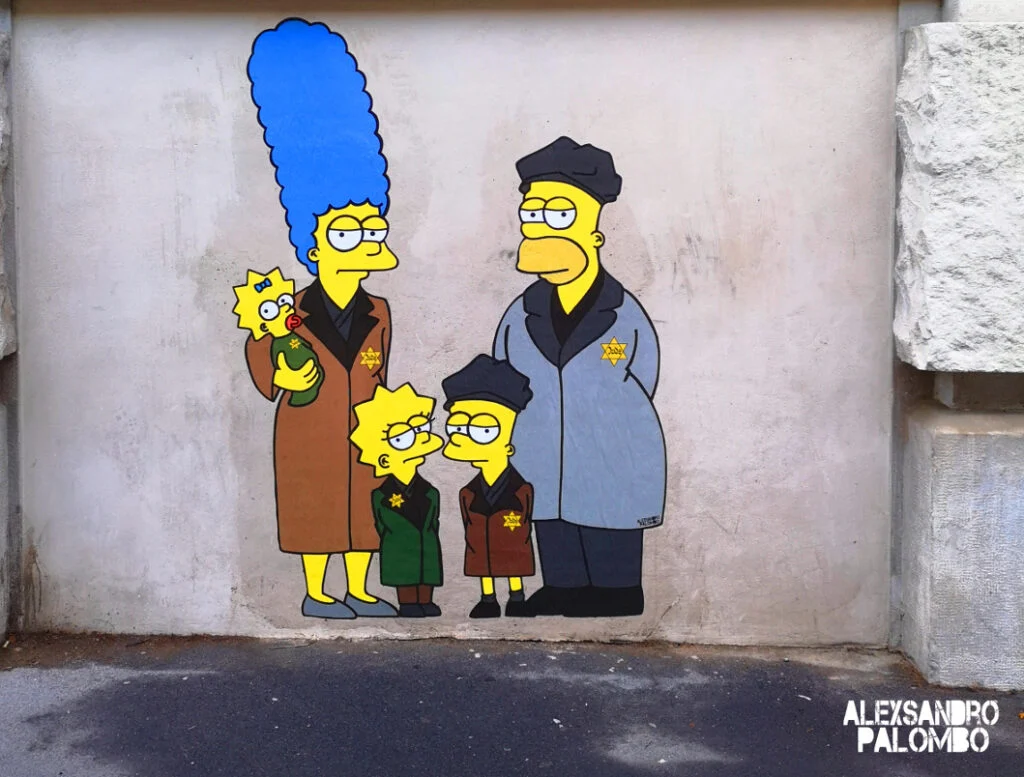
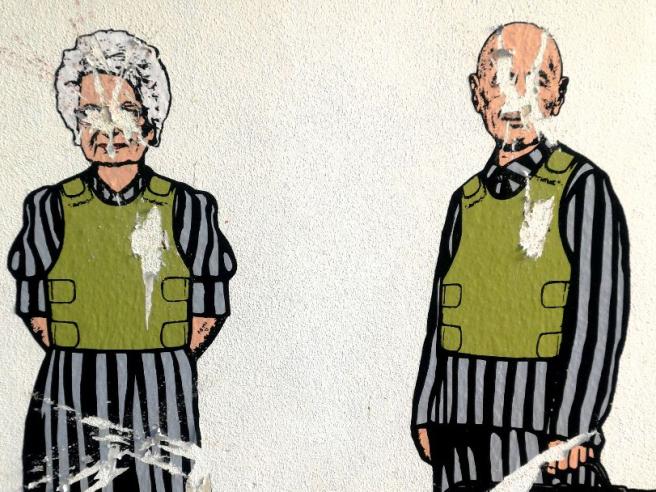
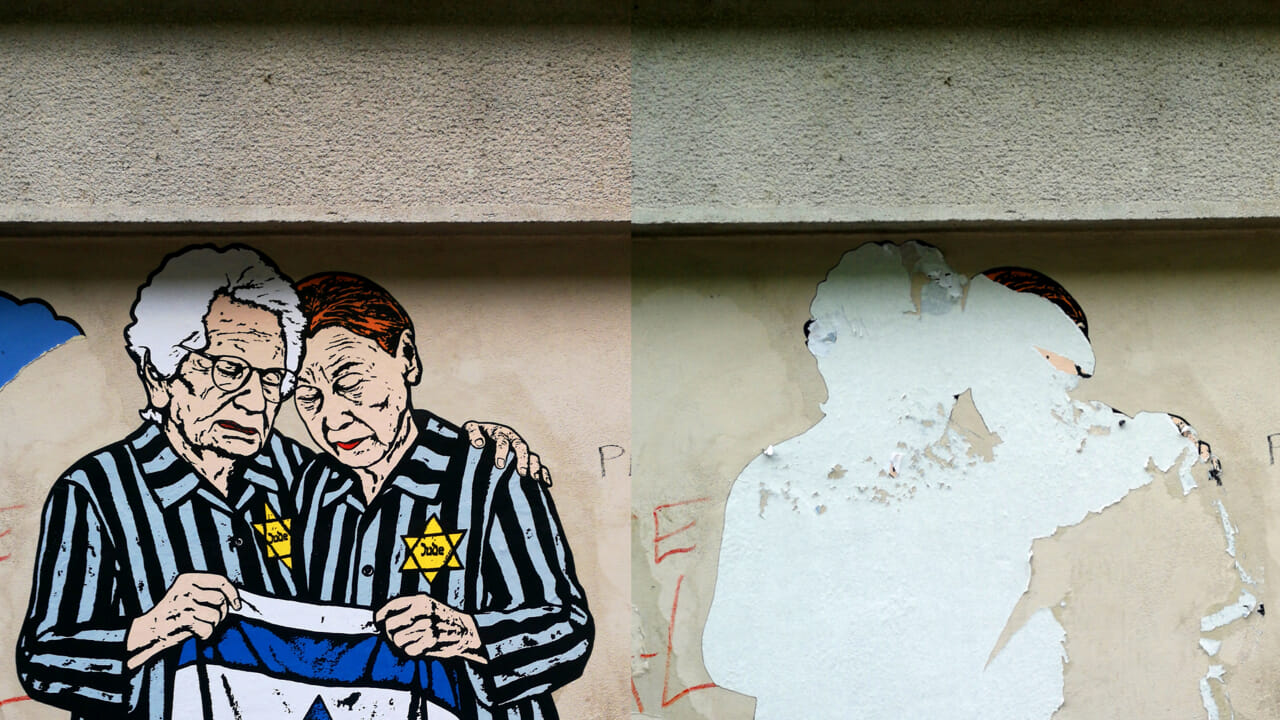
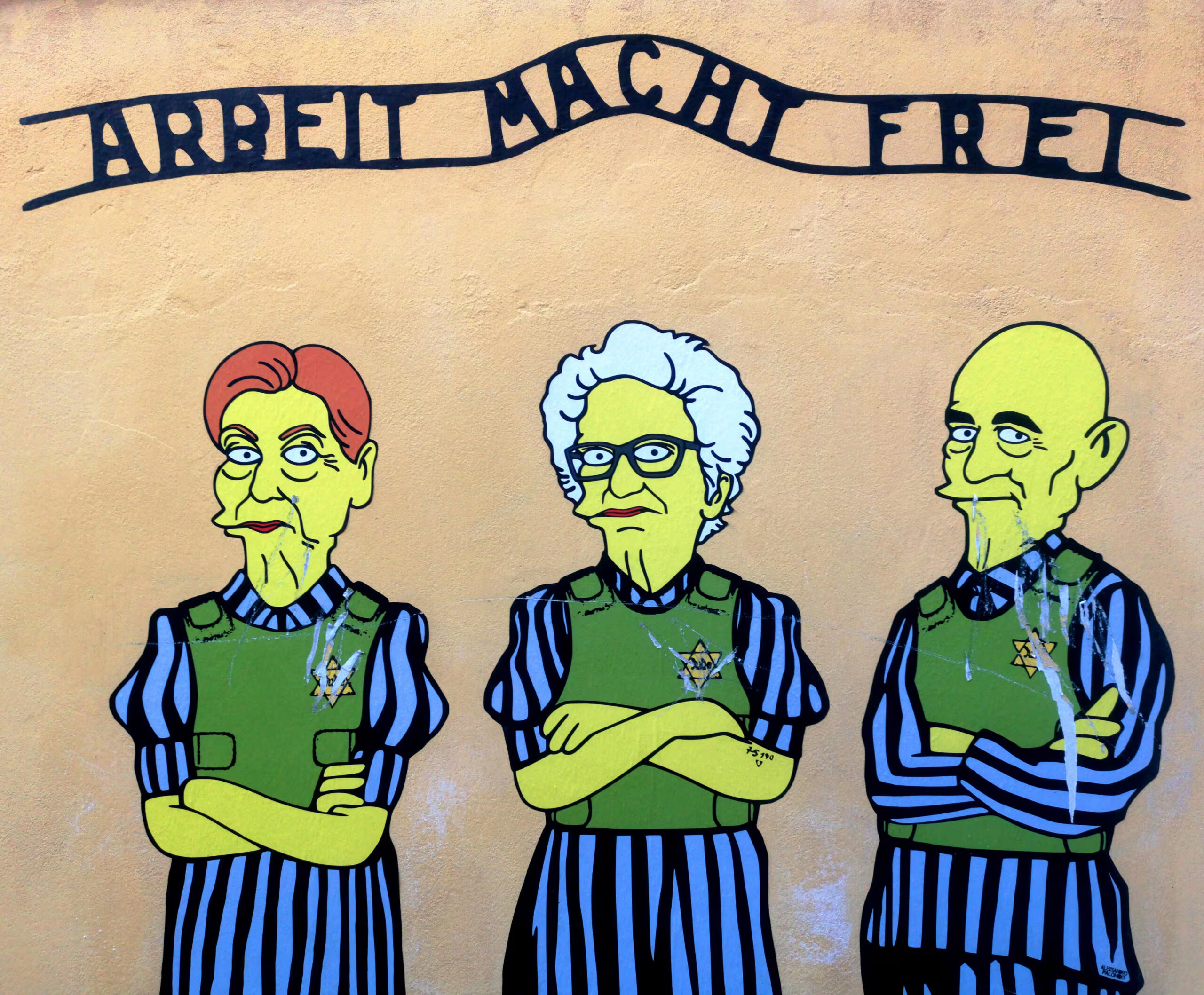
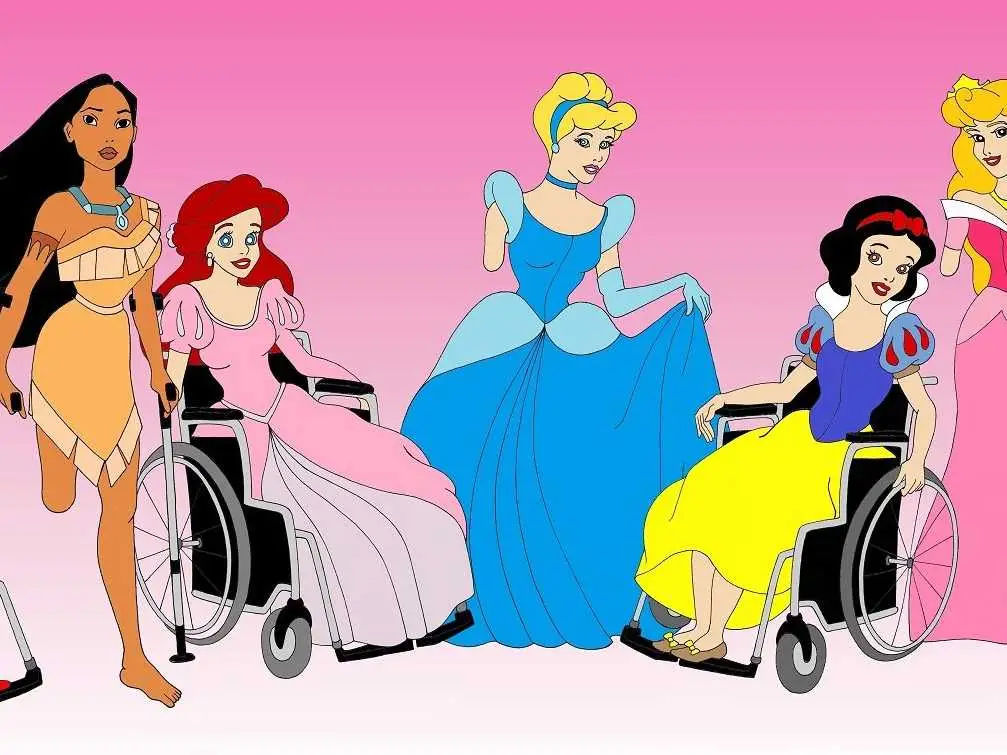
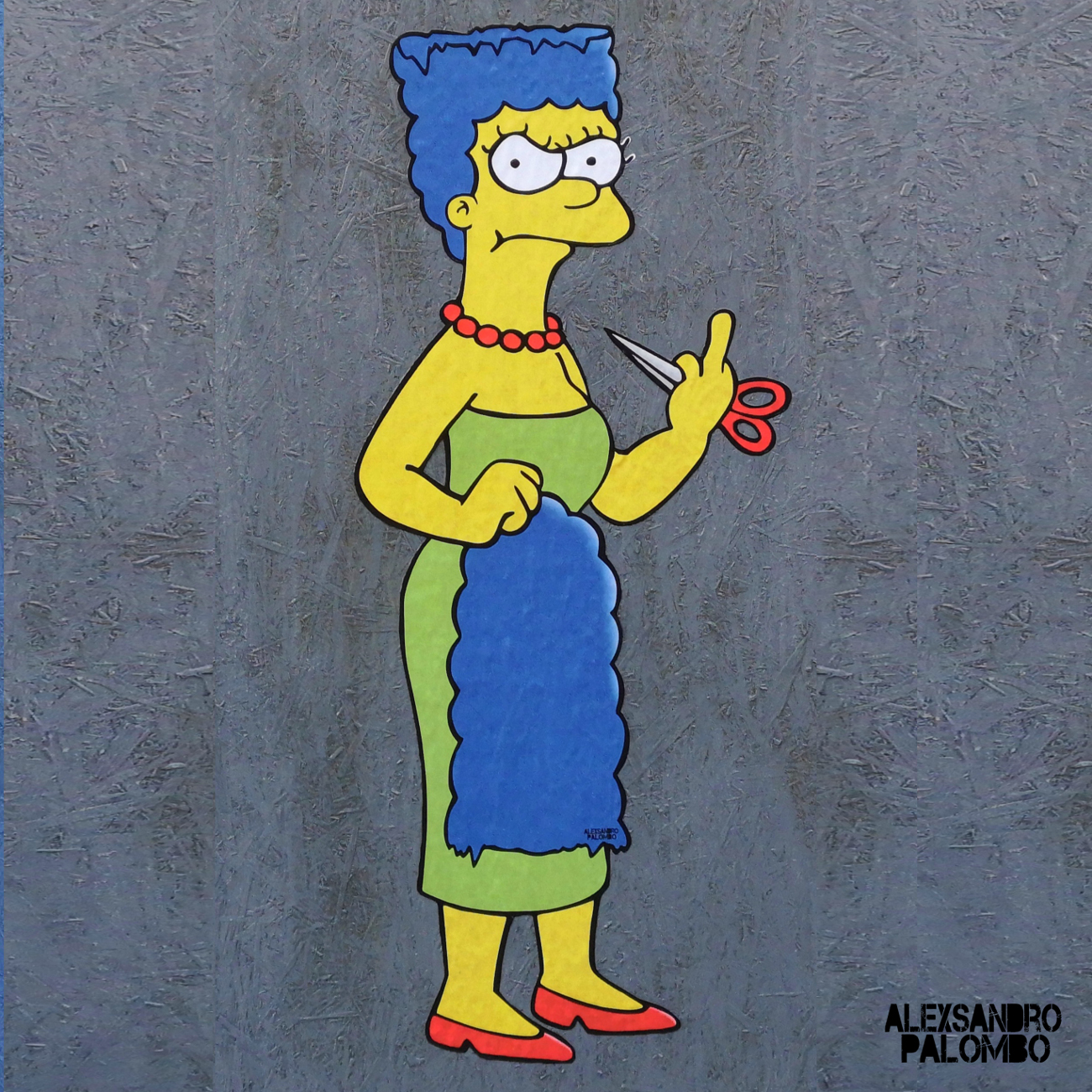
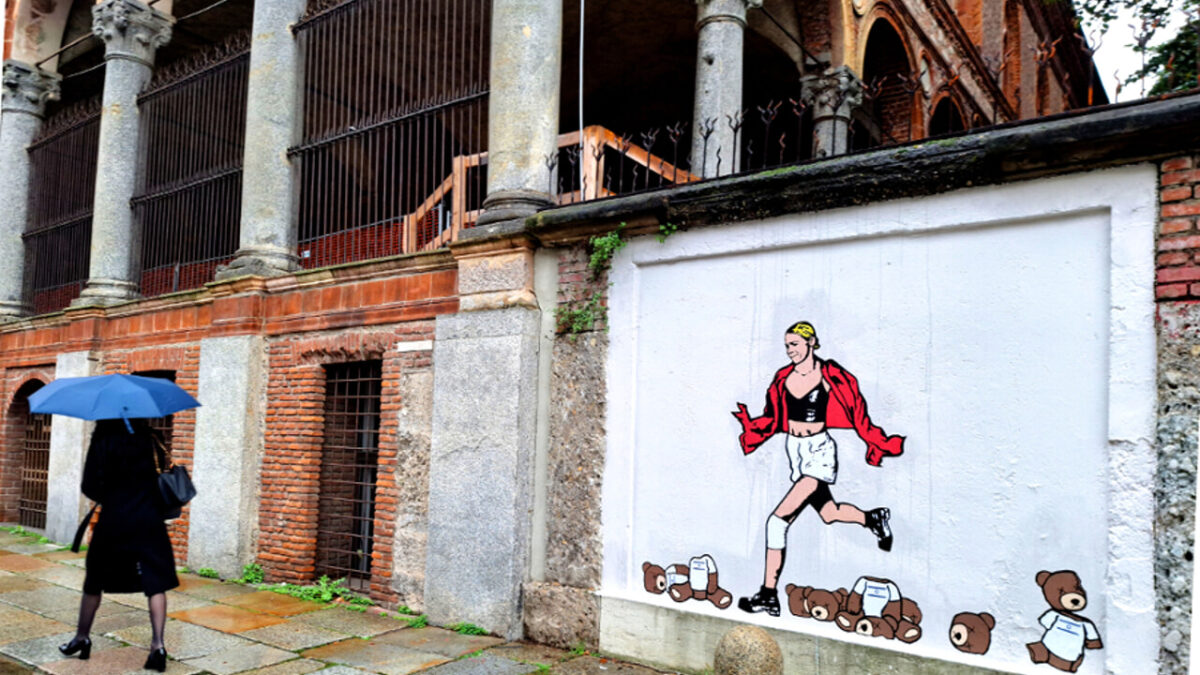
Image above: a girl ragazza runs dafroml Nova Festival, 7 ottobre 2023 © aleXsandro Palombo
